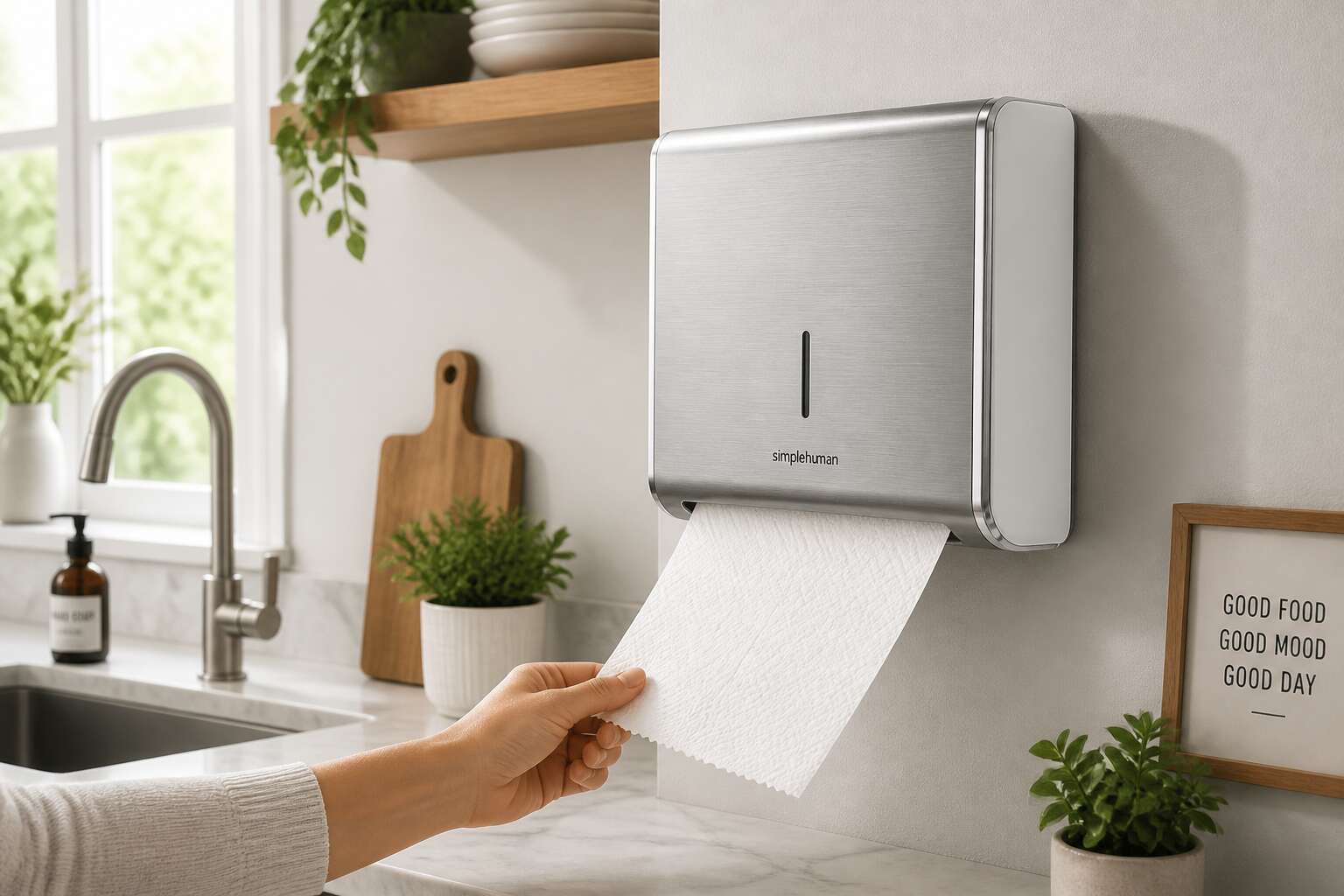
Types of Commercial Towel Dispensers
Automatic Touchless Models
Every hand that touches a manual lever carries a trace of the last user. Automatic touchless models remove that shared surface entirely. In South African washrooms, this changes the dynamic. The unit senses movement and feeds paper without contact. People notice the absence of a button more than the dispenser itself. That is the point.
The technology is simple. Infrared or proximity sensors trigger a fixed sheet length. Some units allow adjustment. Batteries or mains power are required, so load shedding must be considered. These automatic units are a specific category of dispensers paper towel, built for minimal human input.
Considerations:
- Sensor range and response time
- Battery life and backup options
- Roll capacity and refill frequency
- Durability of the casing
Ultimately, touchless dispensers paper towel work best when they are invisible. Nobody should think about the mechanism. When a person dries their hands and moves on, the system has succeeded.
Manual Crank and Lever Systems
Manual crank and lever systems persist in South African washrooms for a reason. They do not blink, sleep, or care whether Eskom has switched off the grid. A steel handle turns, a serrated edge cuts, the user walks away with dry hands.
These units ask more from the person before them. A crank requires a full rotation. A lever demands a firm pull. In exchange, they offer certainty. These dispensers paper towel have no sensor to misalign, no battery to fail, no circuit to corrupt. For high traffic facilities, that is worth something.
When choosing between them, consider the motion itself:
- Crank models feed a continuous length, cut by hand.
- Lever models release a single sheet per press.
- Both tolerate the humidity and dust of a commercial washroom.
Manual options remain a legitimate choice where power reliability is a concern. They are not glamorous. I find that honesty refreshing. They are there, turning when everything else has stopped.
Center-Pull and Roll Towel Options
Center-pull and roll towel options deliver different hand drying rhythms for commercial washrooms. Center-pull dispensers let you catch the edge of a sheet shaped like a teardrop, pulling it free without touching the housing. Roll towel units require a yank to advance a preset length, then present a serrated cut.
I see roll systems in petrol station bathrooms, while center-pull appears in boutique cafés. Both tolerate Durban’s humidity. For facilities comparing dispensers paper towel, the difference is waste control and user habit.
Here is a breakdown:
- Center-pull: less contact, but some users pull multiple sheets.
- Roll towel: a clean tear every time, yet refills need careful stacking.
Neither type needs sensors, so they keep working when the power fails!
Compact and Countertop Designs
Compact and countertop dispensers solve a problem that grows with every square metre you don’t have. A wall mounted unit tucks into a 20 centimetre gap. A countertop model sits flush against the basin, keeping paper within arm’s reach. These options matter in petrol station kiosks, salon washrooms and small offices across South Africa.
The trade-offs are clear once you inspect them side by side:
- Compact units hold shorter rolls, which means more frequent refills.
- Countertop dispensers paper towel show stock at a glance.
- Neither version requires electrical work or sensor calibration.
For a tight layout, the choice comes down to placement. Wall mounting preserves counter space, while a countertop unit suits a vanity with room to spare.
Key Features to Consider
Capacity and Refill Frequency
The rhythm of a busy washroom is dictated by the refill cycle. A dispenser that runs dry mid-afternoon forces staff into an unscheduled restock, disrupting the entire cleaning schedule. In South African facilities, from Johannesburg office towers to Cape Town restaurants, this interruption becomes a daily battle unless capacity is chosen with deliberate foresight.
Large capacity units reduce the frequency of intervention, but they also demand more wall space and a stronger internal mechanism to handle the heavier roll. Smaller units offer a sleeker profile yet require near-constant vigilance. The real question is your traffic volume. A high-usage site needs a dispenser that holds a full jumbo roll to survive the day.
– Measure peak hourly usage to estimate realistic consumption.
– Match the core size to your longest operating period without access to storage.
– Verify that the viewing window clearly shows the remaining paper.
Ultimately, the choice of dispensers paper towel shapes your maintenance routine. The quiet hum of a fully stocked unit in a quiet hallway is the sound of a system that never calls for attention, because every refill happens on your schedule, not an emergency one.
Durability and Material Quality
Ah, the great dispenser showdown. You might think a steel box is a steel box, but spend a week watching a high-traffic restroom in a Johannesburg food court and you will witness a brutal demolition derby. The ablution block is no place for delicate equipment. It is an arena where metal meets grime, where hinges face the relentless assault of wet hands and the occasional frustrated kick.
Material quality is the armour that determines lifespan. A flimsy plastic chassis might look acceptable on a showroom wall, but it will crack under the weight of a jumbo roll or warp in the harsh South African sun if placed near a window. Look for heavy-gauge steel or a robust ABS polymer that can withstand the particular humidity of a Durban coastal climate. This is not a purchase; it is a peace treaty signed with your maintenance team.
When inspecting potential units, focus on the internals. The mechanism is the beating heart, and if it jams, your entire operation stalls. A rust-resistant core is non-negotiable in facilities where condensation is a constant foe.
– Check for welded or sealed seams that prevent moisture ingress.
– Assess the weight of the unit; heavier constructions typically signal better gauge metal.
– Look for a manufacturer that offers a warranty against vandalism or corrosion.
Buying a cartridge based mainly on its price tag is a fool’s errand. You will likely pay the difference in labour costs within a month. A robust unit for your dispensers paper towel needs is not an expense, it is an investment in the daily rhythm of your facility. Making the right call here means you are not just securing a roll of paper; you are securing your schedule against the tyranny of the emergency refill.
Ease of Use and Accessibility
Ease of use is the difference between a guest who leaves satisfied and one who leaves annoyed. The best dispensers paper towel units operate with an intuitive flow. You should be able to approach, pull, and exit without reading an instruction manual. In high-traffic spaces like a Cape Town mall, hesitation causes queues. Accessibility also means thinking about wheelchair users and shorter visitors. The mechanism should require minimal force. A stiff lever or a recessed button becomes a barrier. For maintenance teams, the same principle applies. Loading a new roll should take seconds, not a toolkit.
- Minimal force required for activation.
- Dispense height accessible to all users.
- Refill process manageable with one hand.
These factors determine whether your dispensers paper towel setup feels invisible or infuriating.
Tamper-Resistance and Security
A single vandalised unit can cost a facility more in repairs than the rolls it holds. In busy South African restrooms, tampering is a predictable event. Visitors pull at levers, kick covers, and pry open visible seams. Commercial dispensers paper towel units need concealed locking points and breakaway hinges that take impact without exposing the roll.
Think about what happens during load shedding. A flimsy latch fails the moment a hand finds it in the dark. The best units use a robust core lock that resists picking, yet opens smoothly for staff. Look for anti-pry lips and reinforced corners.
- Concealed fasteners that slow down determined hands
- Shatter-resistant polycarbonate bodies that survive kicks
- Torque-limited screws that prevent cracking from over-tightening
Security is about making the wrong action cost time. When a unit resists tampering, it deters theft. Your dispensers paper towel system should be the last thing anyone notices.
Viewing Window for Low-Stock Alerts
A viewing window provides a direct line of sight into a dispensers paper towel unit. Staff can confirm stock levels without opening the cabinet or disturbing the washroom routine.
Load shedding changes the equation. A small translucent strip becomes useless in a dark corridor. Look for a wide, frosted window that shows the remaining paper even under a phone’s flashlight.
- Oversized windows that reveal the roll at a glance
- Smoke tinted covers that hide smudges yet allow inspection
- Internal guides that keep the roll aligned with the pane
When the window works well, maintenance becomes a quick walk past. The best viewing apertures reduce a manual check to two seconds.
Hygiene and Sustainability
Reducing Cross-Contamination
Moist hands transfer more microbes than dry ones, making the drying process a critical control point. The dispensers paper towel used in a facility either break the chain of transmission or extend it. When a unit releases a clean sheet without touching a lever, the risk drops. Each towel becomes a single use barrier, isolating contamination rather than spreading it.
A sustainable mindset reinforces this benefit. Efficient dispensers reduce waste and lower the frequency of refills, which cuts transport emissions and packaging. Hygiene and sustainability converge because both depend on limiting unnecessary contact. A paper towel used once and discarded holds the contamination; a system that meters out sheets carefully holds the cost down.
Eco-Friendly Material Choices
Choosing a dispenser that works with recycled fibre is a practical move for any facility. In South Africa, where water scarcity makes paper production a sensitive topic, the right dispensers paper towel can reduce waste and environmental impact. Recycled content, unbleached kraft, and bamboo fibre each offer a different trade off.
- Recycled fibre saves trees and uses less water in pulping.
- Bamboo grows fast and needs no pesticides, though it may travel farther.
- Unbleached kraft avoids chlorine, but feels rougher to the touch.
The material choice matters less than the metering mechanism in the best dispensers paper towel. A unit that releases one sheet at a time prevents wasted towels. That conservation is a direct extension of hygiene, since fewer touches mean fewer shared surfaces. When you pair sustainable materials with smart dispensing, you get a system that respects both the user and the planet.
Waste Reduction Strategies
Across South Africa’s commercial hubs, the quiet cost of paper waste is staggering. Facilities discard thousands of rand annually in unused sheets that tumble from a roll and hit the floor, unusable. The strategy for reduction lives inside the mechanics of the dispensing unit itself, not just in the fibre of the roll.
The most effective way to curb consumption is to control access. A dispenser that measures each sheet forces a pause between pulls, breaking the autopilot habit of grabbing a handful. This single action reduces volume pulled by up to 40% in high traffic areas.
– A metered pull cuts per-user consumption.
– A locked internal roll prevents vandalism and theft.
– A clear window reduces premature replacement checks.
The real savings emerge when you consider the entire lifecycle. Fewer towels used means fewer refill cycles, less transport fuel, and a lighter load on municipal waste systems. The right mechanism transforms the simple act of drying hands into a deliberate, resource conscious choice. In a country where every litre of water and every kilowatt counts, this precision is the quiet workhorse of a responsible operation. The dispensers paper towel that measures carefully is the simplest, most direct lever for meaningful conservation.
Compliance with Health Standards
The World Health Organization links proper hand drying to a 50% drop in infection transmission. In South Africa, health inspections now scrutinise every touchpoint, including the towel unit. A compliant dispenser does more than hold paper; it enforces hygiene protocols through controlled dispensing and sealed refill systems. Facilities must demonstrate compliance during audits, and the dispensers paper towel chosen often determines the outcome.
Consider what an inspector expects to see:
- Material surfaces that resist bacterial growth and cleaning chemicals.
- Dispensing mechanisms that prevent moisture transfer between users.
- Refill processes that keep the interior free from dust and debris.
Each point supports health standards while reducing waste. The right dispensers paper towel balance these requirements with sustainable operations, avoiding overuse without compromising hygiene. That balance is the core of modern compliance!
Recyclable and Biodegradable Options
Recyclable and biodegradable options redefine the hygiene routine as a renewable cycle. These towels come from fibres that break down in compost bins or re-enter production without heavy chemical residue. The dispensers paper towel supports that cycle, dispensing material that leaves no long-term burden.
The engineering matters. Fibres designed for quick degradation are often shorter and more delicate. A well-calibrated dispenser handles them smoothly, so the sustainability promise does not fail mid-use.
Here is what to expect from quality options:
1. Towels that decompose within a certified period, often 90 days.
2. Minimal packaging that is itself recyclable or compostable.
Hygiene and conservation operate as one, a quiet victory for South African facilities.
Installation and Maintenance
Mounting Height and Placement
A dispenser mounted too high or too low tests patience more than it dries hands. In South Africa, the standard mounting height for dispensers paper towel sits between 900 and 1100 millimetres from the floor. That range suits most adults, but don’t forget wheelchair users! Keep the bottom edge below 1000 millimetres.
Placement matters as much as height. Install the unit beside the washbasin, not directly above it. Water spray damages paper and mechanics. Leave a clear access zone for refills and repairs. Consider these pitfalls:
– Avoid corners where doors or trolleys can hit the unit.
– Keep 300 millimetres from the basin edge.
– Over a tiled floor simplifies cleaning of dropped towels.
Maintenance becomes easier when the unit sits within sight and reach. For dispensers paper towel, a locking mechanism facing the room saves time during stock checks.
Quick-Change Refill Systems
Every minute spent untangling a jammed roll is a minute lost from the cleaning schedule. Quick-change refill systems solve this problem directly. A cartridge clicks out, a new one clicks in, and the cycle resumes without tools or patience-testing fiddling. For facilities managers covering multiple sites, the labour savings add up quickly.
Installation stays straightforward. Most units mount with three screws and a spirit level. Position the locking mechanism toward traffic flow so staff can swap refills without moving ladders or trolleys. Maintenance crews also value clear access to the internal gears, which remain clean when the refill system seals out dust and moisture.
- Choose one-handed release latches for faster restocking.
- Confirm refill cartridges are locally stocked in South Africa to avoid import delays.
- Test the locking clip during installation to prevent accidental drops.
Dispensers paper towel with quick-change refills cut downtime and keep washrooms operational. I have timed restocking at under two minutes from unboxing to full stock, an efficiency that matters when high-traffic facilities cannot afford empty units.
Cleaning and Sanitizing Tips
In the coastal corridors of Durban or the dry highveld air of Gauteng, the washroom environment changes rapidly. A dispensers paper towel unit mounted today can face condensation, chalky water stains, and abrasive cleaning agents within a week. The installation itself is only half the story. The seal around the screw heads and the alignment of the locking clip determine whether moisture seeps into the gears or stays on the surface where it belongs.
Every fortnight, I take a soft brush to the internal mechanism and wipe the exterior with a cloth dampened in warm water and a neutral detergent. Harsh bleach strips the plastic’s protective layer and leaves micro-cracks where bacteria collect.
- Check the release latch for grit that could impede one-handed access.
- Inspect the viewing window for fogging, which indicates a broken gasket.
This small ritual extends the life of the dispensers paper towel unit and keeps the dispensing action smooth for everyone who relies on it.
Troubleshooting Common Jams
There is a special kind of rage reserved for a dispensers paper towel unit that jams in a Johannesburg office. The paper is visible, glorious, and utterly unreachable. The culprit is rarely the paper itself. It is usually the installation.
- A bracket mounted 2 degrees off plumb creates friction that binds the roll.
- Overtightened screws warp the backplate and pinch the mechanism.
- A misaligned locking clip lets the cover sag and catch the edge of the sheet.
When the gears grind, do not force the crank. That is how teeth break. Open the housing, remove the jammed towelling, and inspect the spindle for a plastic burr left over from manufacturing. In coastal humidity, paper edges swell and weld together.
For a stubborn jam, pull the sheet downward at an angle instead of straight out. Straight pulls lock the clutch. Angled pulls feed the rollers. If the dispensers paper towel refuses to move altogether, lift it off the wall and check the mounting holes for water damage behind the bracket.
Replacement Parts and Support
Any dispenser is only as faithful as the hands that fit it. I have seen a sound dispensers paper towel unit fail within a week because someone used zinc screws in a coastal environment. Corrosion sets in fast under Durban humidity. Use stainless steel fixings and a spirit level! The bracket must carry the load, not the backplate.
Maintenance is quarterly. Open the housing and inspect the spindle bushings for wear. A wobbly spindle tears towels and shortens roller life. Replacement parts should come from the original manufacturer. Generic cams and clutches differ by a millimetre, and that millimetre breeds malfunction. Source spares from a local distributor with a catalogue of the fragile bits. Johannesburg and Cape Town both have reliable suppliers.
Keep these in the storeroom:
- Spindle bushings
- Spare cam and clutch
- Cover hinges
- Locking clips
A maintained dispensers paper towel gives you no trouble.
Cost and Efficiency
Initial Purchase vs. Long-Term Savings
When a facility manager in South Africa first eyes the price tags on commercial units, the cheaper models often look persuasive. That initial sticker price, however, rarely represents the true cost of operation. A low-cost unit that jams frequently or dispenses excess paper will drain your budget through increased refill labour and higher product consumption. This is especially true during load-shedding when staff may be irritable and less patient with a faulty mechanism.
The real financial picture emerges over a twelve-month cycle. A robust, professionally installed unit might command a higher upfront fee, but it pays you back through fewer maintenance call-outs and a longer operational lifespan. You are effectively buying peace of mind, not just a piece of metal or plastic. When you factor in the cost of the paper itself, which is a recurring expense, the efficiency of the dispenser becomes your primary cost control tool. A controlled, one-at-a-time release can cut usage by a significant margin compared to a unit that spools out extra sheets.
Consider the total cost of ownership rather than the purchase order alone.
– Initial cost: The invoice price for the hardware, brackets, and mounting accessories.
– Installation fees: Whether you use in-house staff or a contractor.
– Refill frequency: How often a staff member needs to stop their duties to replace the roll.
– Paper waste: The percentage of the roll that ends up as litter on the floor or clogging the drain.
– Durability: The expected lifespan measured in years, not months, which is a direct factor in your replacement budget.
The hidden inefficiency of cheap hardware usually surfaces in high-traffic washrooms. When a unit fails, users often pull more paper than they need just to get a sheet that tears cleanly. That waste adds up to hundreds of rands lost in a single quarter. Conversely, investing in reliable dispensers paper towel ensures that the unit operates with the same consistency on day three hundred as it did on day one. The long-term savings are not just found in the paper roll, but in the time your cleaning staff saves by not fiddling with broken gears or tangled cores. In the long run, efficiency is a function of reliability, and reliability is a function of the initial investment you are willing to make.
Usage Cost Per Hand Dry
Each hand dry carries a hidden price tag that few facility managers calculate. The true cost per hand dry in a South African washroom depends on the efficiency of your dispensers paper towel and the behaviour of your visitors. A single pull from a poorly adjusted unit can release three sheets instead of one. That waste multiplies across every shift, every visitor, every day!
In our experience, the cost per hand dry includes more than the price of the roll. It covers the labour to refill, the water to clean tangled paper from floors, and the frustration of users who grab extra paper because the machine failed them. When you switch to reliable dispensers paper towel, you gain control over that unit cost.
Here is an example of what to measure:
- Sheets used per dry.
- Paper cost per sheet.
- Refill labour per roll.
- Waste percentage per week.
Tracking these numbers reveals the real efficiency of your washroom.
Reducing Paper Waste with Controlled Dispensing
Controlled dispensing is where cost efficiency actually happens. A unit that doles out one sheet instead of three changes the entire cost structure. We have watched facilities trim paper usage by swapping the mechanism alone.
The principle is simple. Visitors stop grabbing extra paper when the machine gives them exactly what they need. No more ‘grab a handful just in case’ behaviour!
Consider the numbers from a typical install:
- Sheets per dry: 1.2 with controlled dispensing versus 3.5 without
- Waste percentage: drops from 30% to under 5% within weeks
Those figures show up in the procurement records. Reliable dispensers paper towel units pay for themselves quickly, because the savings come from avoided waste rather than cheaper rolls. In a South African facility, that distinction matters. The right dispensers paper towel units turn a minor line item into a repeatable saving month after month.
Energy and Battery Considerations
Batteries rarely get the attention they deserve. The power source inside your dispensers paper towel unit determines whether that touchless sensor operates flawlessly or drains your janitorial budget. Alkaline cells are standard, but lithium options offer longer shelf life.
Consider the efficiency of the motor itself! Some units pulse the dispensing mechanism instead of running a continuous cycle, which cuts energy draw substantially. A simple audit might reveal older models consuming twice the power for the same output. In a country where load shedding is a reality, low-energy consumption is practical.
- Check the standby current, often listed in microamps
- Review the battery door design for corrosion resistance
When you compare monthly costs, battery expense is minor. The real saving appears when you avoid replacement schedules. Reliable dispensers paper towel systems with efficient circuitry keep maintenance staff on better tasks. That is the efficiency procurement teams value.
Bulk Buying and Refill Compatibility
Bulk buying transforms the economics of washroom supplies. When you purchase refills in volume, the unit price drops considerably. Yet bulk only pays off if your dispensers paper towel units accept the exact rolls you stock. A mismatch forces emergency single-pack purchases, which quietly erases the savings.
Refill compatibility deserves scrutiny before you commit to a system. Verify these details:
- Roll width and core diameter must align precisely.
- Stub roll transfer, if supported, changes how you batch orders.
- Interfold sheets versus continuous rolls alter the product you can buy.
Standardising on one platform lets you negotiate supplier contracts with confidence. The warehouse team appreciates a single SKU, and the facilities manager tracks consumption against a clear baseline. That is where bulk buying earns its keep. A compatible dispensers paper towel range removes guesswork from procurement.



0 Comments